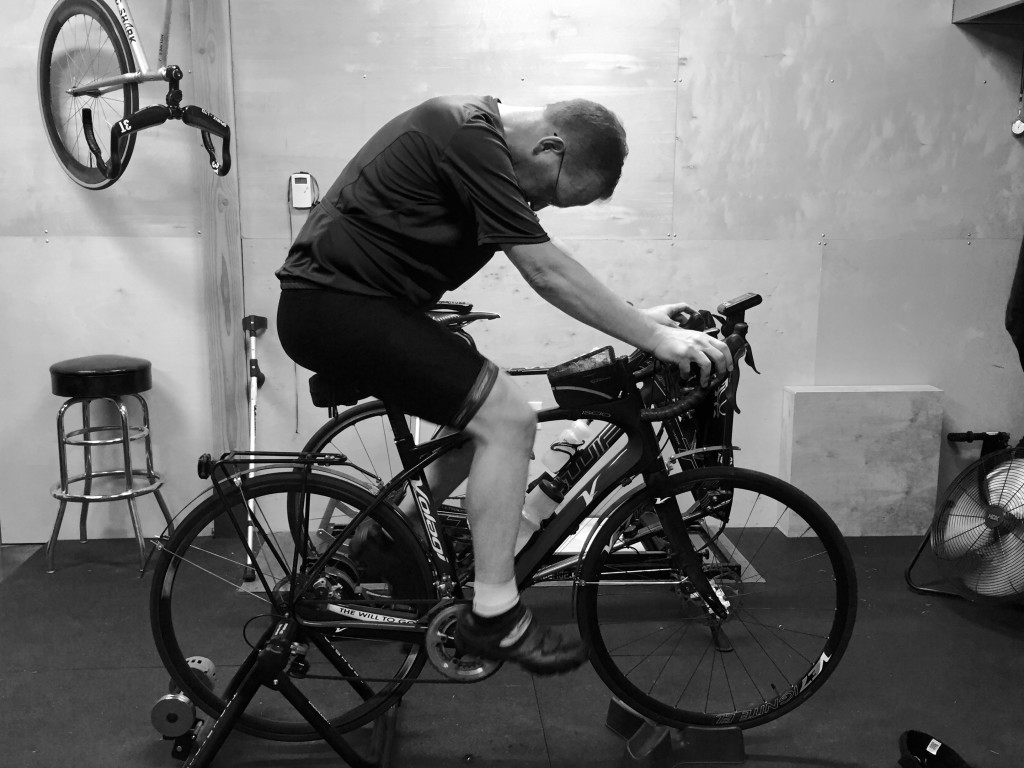
Yesterday I had one of my newer clients, Howard, come into the gym and do a Functional Threshold Test (FTP for short).
Howard doesn’t race. His main objective is one that a lot of people would like to accomplish but few actually do anything about – lose weight and be healthier. His athletic background consists of “High school and college soccer, no other athletic activity”. He was quite honest on his intake form when he stated “I don’t like gyms or working out for its own sake, I love cycling. Cycling is what motivates me. I figure if I can become a better cyclist – faster, stronger, etc. – the weight thing will happen.” Fair enough.
Regardless of the level – world class, amateur, recreational, etc, – for any training to be efficient and effective you need to establish some sort of baseline to work from. In the gym that typically means doing a 1 rep max test. Pick up the heaviest weight you can for a particular lift and then prescribe a set – rep – % of 1 RM workout specific to the objective going forward. For endurance sports, in this case cycling, your measuring sticks are typically power, heart rate or a combination of the two.
Howard has a heart rate monitor so I ran him through a testing protocol yesterday to establish his threshold heart rate. There are issues with using heart rate such as cardiac drift and heart rate lag but it still can be quite effective (and far better than relying on RPE – Rate of Perceived Effort).
The Test:
-Warm up 15-20 minutes – gradually increase pace
-3 x 1 minute high cadence efforts [100+RPM] with 1 minute rest interval
-5 minute easy spinning
-5 minute effort [Max for 5 minutes – so pace]
-5 minute easy spinning
-1 min All Out Max
-5 min easy spinning => 5 minute gradually increase pace
-20 minute effort [max for 20 minutes – so pace]
-10 minute cool down
For any test to be effective you want the subject to be rested coming into it and then run them through a good warm up and make sure that they are “opened up” for the effort.
